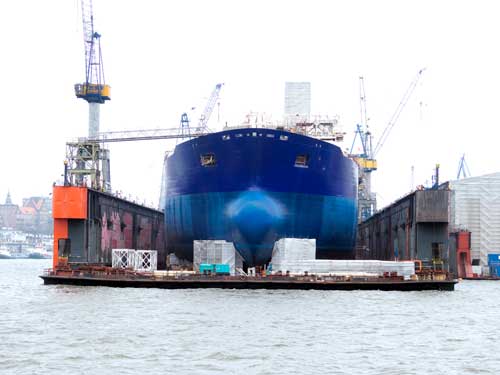
Following on from our article on the potential cost savings offered by automation in shipbuilding, we illustrate the possible savings using three illustrative examples. Using a small yacht, a medium-sized frigate and a large cruise ship as examples, we show how Cost savings through automation to total the labour hours, energy, materials and finishing work under the assumed conditions.

Table of contents
- What assumptions underlie the calculation?
- How much does automation save on a small yacht?
- How much does automation save on a medium-sized frigate?
- How much does automation save on a large cruise ship?
- What conclusions can be drawn from the calculation examples?
- Conclusion
- How does Zeitarbeit International support shipyards in implementing automated processes?
- FAQ
- How much can be saved in total through automation on a small yacht?
- How much are the total savings on a medium-sized frigate?
- How much are the total savings on a large cruise ship?
- Which cost factor yields the greatest savings through automation?
- Do these calculation examples apply to every shipbuilding project?
- Why are the cost savings particularly high in mass production?
- Will qualified staff still be needed despite these cost-cutting measures?
- Useful information
Estimated reading time: 8 minutes
What assumptions underlie the calculation?
Here are the assumptions that apply to this example:
- The following assumptions apply to the calculation examples:
- Automation reduces the number of manual working hours by 30 %.
- The wage cost is €35 per hour.
- Automated processes reduce energy consumption by 10 %. The assumed energy price is €0.20 per kWh.
- Material wastage is reduced by 15 %.
- Thanks to automation and the resulting increase in precision, the proportion of rework out of total working hours has fallen from 5 % to 1 %.
The following initial values are used for the three types of vessel:
| Type of vessel | Working hours | Cost of materials | Energy consumption |
|---|---|---|---|
| Small yacht | 20,000 hours | 300.000 € | 50,000 kWh |
| Medium-sized frigate | 150,000 hours | €2.5 million | 500,000 kWh |
| Large cruise ship | 1.2 million hours | €25 million | 5 million kWh |
How much does automation save on a small yacht?
For the small yacht, 20,000 working hours are taken as the baseline for completion. Given a saving of 30 % in this area, this results in:
The construction of the small yacht is estimated to take 20,000 working hours. A reduction of 30 % results in the following saving:
20,000 hours × 0.30 = 6,000 hours
Energy consumption falls by 10 % from 50,000 kWh:
50,000 kWh × 0.10 = 5,000 kWh
Assuming an energy price of €0.20 per kWh, this results in a cost saving of:
5,000 kWh × 0.20 €/kWh = 1,000 €
The following calculation assumes a reduction in total material costs of 15 %. With an initial figure of €300,000, this gives:
The proportion of rework in the total working hours falls from 5 % to 1 %. This results in the following workload:
Before automation: 20,000 hours × 0.05 = 1,000 hours
After automation: 14,000 hours × 0.01 = 140 hours
The difference is:
1,000 hours − 140 hours = 860 hours
With labour costs of €35 per hour, this amounts to:
860 hours × €35 per hour = €30,100
The following overview summarises the calculated savings. The total figure is based on the assumption that the savings on post-processing may be included in addition to the hours of work saved.
| Cost centre | Savings |
|---|---|
| Working hours | 6,000 hours / €210,000 |
| Energy | 5,000 kWh / €1,000 |
| Material | 45.000 € |
| Post-processing | 860 hours / €30,100 |
| Total savings | 286.100 € |
How much does automation save on a medium-sized frigate?
It is estimated that 150,000 working hours are required to build a medium-sized frigate. Automation saves 30 % of these:
150,000 hours × 0.30 = 45,000 hours
The remaining workload is:
150,000 hours − 45,000 hours = 105,000 hours
With labour costs of €35 per hour, this results in the following saving:
45,000 hours × €35 per hour = €1,575,000
Energy consumption falls by 10 % from 500,000 kWh:
500,000 kWh × 0.10 = 50,000 kWh
At an energy price of €0.20 per kWh, this results in the following cost savings:
50,000 kWh × 0.20 €/kWh = 10,000 €
A reduction of 15 % is assumed for total material costs. Based on an initial figure of €2.5 million, this gives:
€2,500,000 × 0.15 = €375,000. The proportion of rework in the total working hours falls from 5 % to 1 %. This results in the following workload:
Before automation: 150,000 hours × 0.05 = 7,500 hours
After automation: 105,000 hours × 0.01 = 1,050 hours
The difference is:
7,500 hours − 1,050 hours = 6,450 hours
With labour costs of €35 per hour, this amounts to:
6,450 hours × €35 per hour = €225,750
The following overview summarises the calculated savings. Here, too, the total figure is based on the assumption that post-processing may be accounted for separately.
| Cost centre | Savings |
|---|---|
| Working hours | 45,000 hours / €1,575,000 |
| Energy | 50,000 kWh / €10,000 |
| Material | 375.000 € |
| Post-processing | 6,450 hours / €225,750 |
| Total savings | 2.185.750 € |
How much does automation save on a large cruise ship?
The construction of the large cruise ship is estimated to require 1.2 million working hours. Automation will save 30 % of these:
1,200,000 hours × 0.30 = 360,000 hours
The remaining workload amounts to 840,000 hours. Assuming labour costs of €35 per hour, this results in the following saving:
360,000 hours × €35 per hour = €12,600,000
Energy consumption is falling by 10 % from a starting point of 5 million kWh:
5,000,000 kWh × 0.10 = 500,000 kWh
Assuming an energy price of €0.20 per kWh, this corresponds to a cost saving of:
500,000 kWh × 0.20 €/kWh = 100,000 €
A reduction of 15 % is assumed for the total material costs. Based on an initial figure of €25 million, this gives:
The proportion of rework in the total working hours falls from 5 % to 1 %. This results in the following workload:
Before automation: 1,200,000 hours × 0.05 = 60,000 hours
After automation: 840,000 hours × 0.01 = 8,400 hours
The difference is:
60,000 hours − 8,400 hours = 51,600 hours
With labour costs of €35 per hour, this amounts to:
51,600 hours × €35 per hour = €1,806,000
The following overview summarises the calculated savings. The total figure, however, is based on the assumption that reworking may be calculated separately.
| Cost centre | Savings |
|---|---|
| Working hours | 360,000 hours / €12,600,000 |
| Energy | 500,000 kWh / €100,000 |
| Material | 3.750.000 € |
| Post-processing | 51,600 hours / €1,806,000 |
| Total savings | 18.256.000 € |
What conclusions can be drawn from the calculation examples?
The calculation examples can be adapted to specific construction projects using project-specific values. Even on the basis of the assumed values, potential savings become clear.
Even with small yachts, these assumptions result in significant savings, particularly in terms of labour and material costs, as well as post-production work. If several boats are manufactured in series, the savings can add up to considerable sums over the course of the entire production run.
In the case of larger vessels that are built to individual specifications, the focus is on the savings to be made within the specific project. Given the high labour costs and material requirements, even a single construction project can result in substantial savings.
We will set out further conclusions in a forthcoming article.
Please note: These sample calculations are not a substitute for an individual project quotation. The assumed values can be replaced with actual data from your shipyard. Regardless of the level of automation, qualified personnel are still required for planning, supervision and follow-up work. You can find information on the legal framework governing the supply of temporary staff in our article on Temporary Employment Act (AÜG).. You can find the background to the assumptions used here in our previous post on the Potential savings from automation in shipbuilding.
Conclusion
The calculation examples illustrate the potential savings that automation can offer in shipbuilding. Based on the assumptions made, and taking post-processing costs into account separately, the calculated savings amount to €286,100 for the small yacht, €2,185,750 for the medium-sized frigate and €18,256,000 for the large cruise ship. This means that there is significant potential for savings both in the mass production of smaller boats and in the bespoke construction of large ships. The actual amount of the savings must be calculated individually for each project.
How does Zeitarbeit International support shipyards in implementing automated processes?
Zeitarbeit International We recruit qualified specialists from Eastern Europe for the German shipbuilding industry – from operating automated systems to finishing work and quality assurance. We ensure that all procedures are carried out in full compliance with the German Temporary Employment Act (AÜG) and provide suitable specialists on a project-by-project basis.
FAQ
How much can be saved in total through automation on a small yacht?
In the example calculation, the total saving for a small yacht amounts to €286,100. This comprises savings on labour, energy, materials and rework costs.
How much are the total savings on a medium-sized frigate?
In the example calculation, the total saving for a medium-sized frigate amounts to €2,185,750.
How much are the total savings on a large cruise ship?
In the example calculation, the total saving for a large cruise ship amounts to €18,256,000.
Which cost factor yields the greatest savings through automation?
In all three examples, the greatest savings are achieved by reducing working hours. Savings on material costs come second.
Do these calculation examples apply to every shipbuilding project?
The calculation examples are based on simplified assumptions. For a project-specific calculation, these must be reviewed in the light of the actual conditions and the initial values replaced with real project data.
Why are the cost savings particularly high in mass production?
In series production, the savings per boat add up over the entire production run. This means that even with smaller boats, significant overall savings can be achieved.
Will qualified staff still be needed despite these cost-cutting measures?
Even automated processes need to be planned, monitored and, where necessary, adjusted. Qualified specialists therefore remain indispensable.
The total amounts quoted have been accepted as they stand; the discrepancies regarding material costs and reworking mentioned earlier remain.
Useful information