
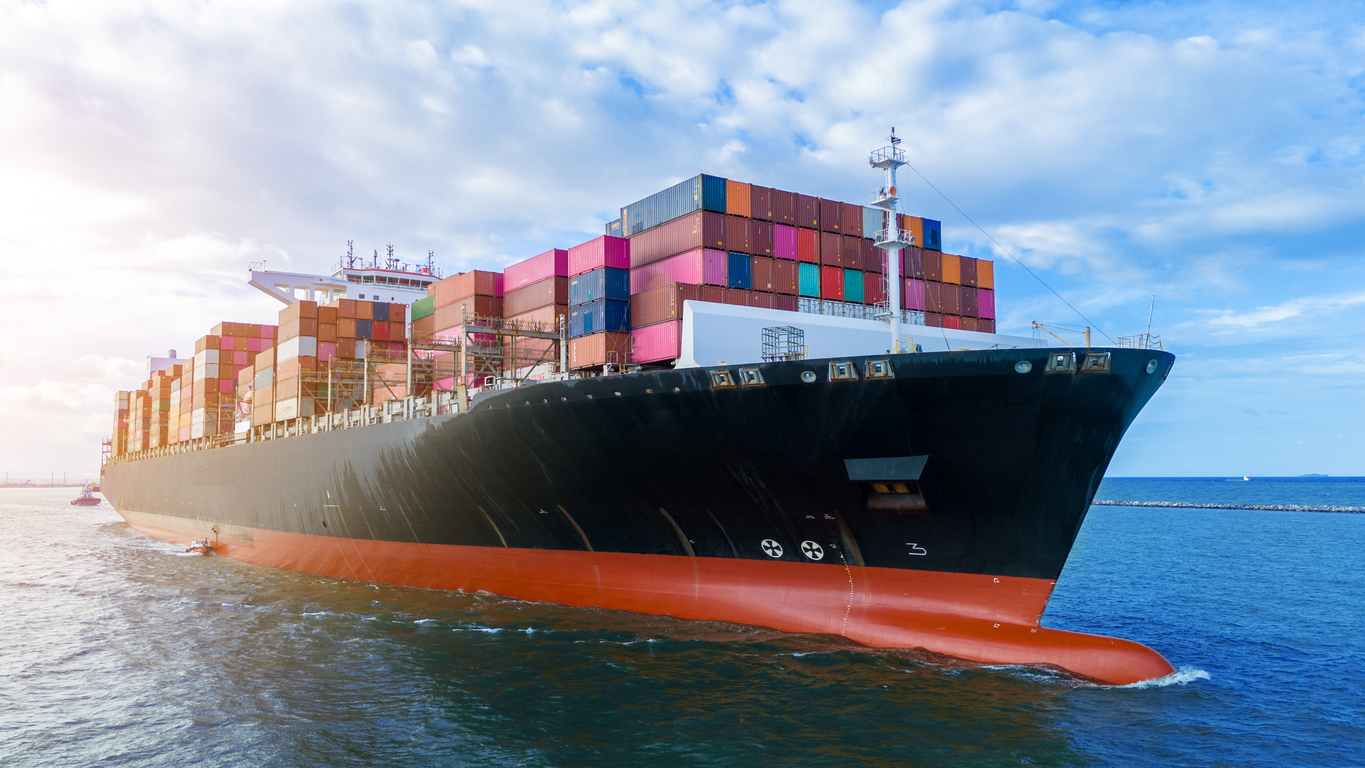
Two types of ship that could hardly be more different - and yet both form the basis of modern logistics: Naval supply vessels as all-rounders with a depth of military experience, container ships as silent engines of world trade. This article shows what characterises them technically, what challenges their construction entails and why both are strategically important for German shipbuilding.
Table of contents
- What do supply ships do in the civilian sector?
- How important are container ships?
- What does the design and construction of a container ship look like?
- What do size classes and TEU mean?
- How are propulsion, fuel and emissions management carried out on container ships?
- How do navigation, communication and harbour logistics work?
- FAQ on supply and container ships
- Further topics
Estimated reading time: 8 minutes
What do supply ships do in the civilian sector?
Naval suppliers are all-rounders - and that is precisely what makes them so valuable for the German shipbuilding industry. Anyone who can build a ship that functions simultaneously as a tanker, workshop, infirmary, helicopter carrier, weather station and tugboat gains a depth of experience that can hardly be replaced by other projects.
This experience is not limited to the military sector. As an overall system, supply ships are much closer to civilian ships than classic warships. Anyone who understands how to integrate a hospital into a ship without compromising the crew accommodation can solve the same problem on an expedition cruise ship. Anyone who installs hangar systems for helicopters in a supply ship knows how this works on a research vessel.
Propulsion systems that combine range with speed, complex energy supply in confined spaces, oversized systems as a reserve for emergencies - all of this can be directly transferred to explorer yachts, research vessels and specialised vehicles.
It is easier to transfer military systems to the civilian sector via the supplier as an intermediate stage than directly from a combat ship. The supplier is the link - close enough to the navy to understand military requirements, close enough to civilian shipbuilding to carry out the transfer.
How important are container ships?
Despite aeroplanes, the internet and global logistics networks, the lion's share of global trade is still transported by sea. 80 to 90 per cent of all goods transported worldwide are carried by ship. The reason is simply physics.
For comparison: The C-5 Galaxy, one of the largest transport aircraft in the world, transports almost 130 tonnes of payload. A single modern container ship transports over 200,000 tonnes - the equivalent of more than 1,500 fully loaded transport aircraft.
What makes container ships the ideal means of transport are two factors: the sheer capacity with a small crew, which makes transport per tonne extremely cost-effective, and standardisation. Standardised containers can be loaded, handled and transported worldwide - without repacking, without special handling, in any port in the world.
What does the design and construction of a container ship look like?
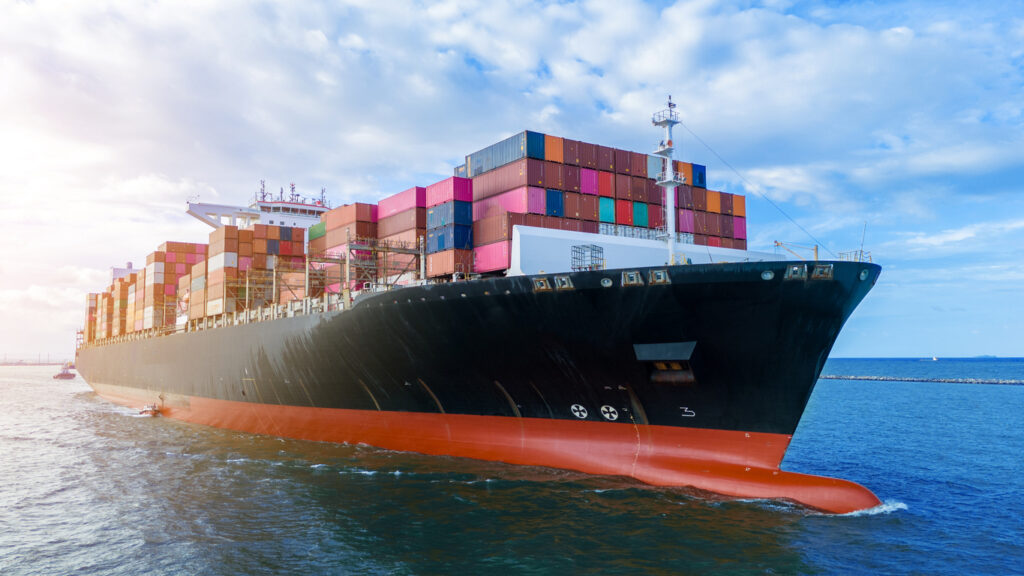
The hull of a container ship is designed to maximise volume with a wide deck area. The width allows containers to be stacked in many rows next to each other; the length multiplies the capacity. Below deck, a Cell structure the containers securely in place - even when heavy seas move the ship in all directions.
On deck, load securing systems, cranes and locking technology complement the structural measures. Modern container ships can load and unload themselves in practically any port without having to rely on harbour cranes.
The entire hull - especially the underwater area - is hydrodynamically optimised. The shape is designed to minimise flow resistance, which has a direct impact on fuel consumption. Reinforced structures in the hull and deck absorb the enormous forces resulting from tens of thousands of tonnes of load, the movements of the ship and the propulsion system.
This is supplemented by stability systems that reduce the roll of the ship - but they cannot completely suppress it in heavy weather.
What do size classes and TEU mean?
TEU stands for Twenty Foot Equivalent Unit - the standard unit of measurement for container capacity. One TEU corresponds to a 20-foot container (approx. 6.1 metres in length). A 40-foot container occupies two TEU.
| Size class | Capacity (TEU) | Typical use |
|---|---|---|
| Feeder shaft | 1,000 - 3,000 TEU | Feeder services, smaller harbours |
| Panamax | 3,000 - 5,000 TEU | Old Panama Canal locks (reference size) |
| New Panamax | 10,000 - 14,500 TEU | Expanded Panama Canal locks |
| Ultra Large Container Ship (ULCS) | up to 24,000 TEU | Main routes Asia - Europe |
A ship with a capacity of 3,000 TEU can transport 3,000 20-foot containers or 1,500 40-foot containers - or any mixture of both types. The growing size of ships not only places technical demands on construction, but also on harbours, locks, canals and shipyards, which have to grow accordingly.
An interesting side note: many container ships still have a few passenger cabins - a remnant from the time when cargo ships generally also carried passengers. The cabins are simple, but inexpensive and functional - a niche for travellers seeking the seclusion and authenticity of a cargo ship crossing.
How are propulsion, fuel and emissions management carried out on container ships?
The propulsion of a container ship is designed for endurance and efficiency, not speed. Two engine types dominate:
- Two-stroke low-speed engine: Rotate very slowly, work extremely efficiently and are the norm for large ships. Outputs of up to 60,000 kW - a single motor can reach the size of a multi-storey building.
- Four-stroke medium-speed motorbike: For smaller or faster ships, often in a multiple arrangement.
Particularly noteworthy: large engines on container ships can disengage individual cylinders for maintenance work while the other cylinders continue to run. Each cylinder is largely an independent unit with its own power supply - this enables maintenance to be carried out during operation without bringing the engine to a complete standstill.
Fuel change and emissions management
Different sea areas are subject to different emissions regulations. In so-called Emissions Control Areas (ECAs) - for example around Europe and North America - only low-sulphur fuels are permitted. On the open sea, the regulations permit more favourable heavy fuel oils.
Switching between fuels is not a simple process. The entire tank system - from the storage tanks to the day tank to the injection into the engines - must be completely emptied of the old fuel and filled with the new one before the changeover is complete. This process takes many hours, sometimes a whole day.
How do navigation, communication and harbour logistics work?
A container ship is not a transporter that is fully loaded somewhere and completely unloaded somewhere else. It is a rolling system: at each harbour, some containers leave the ship and others are added. Computer systems continuously calculate which containers are where, which need to be unloaded next and which weight distribution maintains stability.
Navigation and communication systems ensure that the ship knows its exact location and that the operator can track its course in real time. This not only helps to avoid collisions, but also to plan harbour capacities, loading times and connecting traffic.
Added to this is ballast water management: water that is taken on as ballast in one port must not be discharged untreated in another port - it could introduce alien organisms. Corresponding treatment systems are now mandatory in almost all new buildings.
FAQ on supply and container ships
Why are supply ships particularly valuable for German shipbuilding?
They combine military and civilian requirements in one ship and thus provide experience that can be directly transferred to civilian projects such as research vessels, explorer yachts or specialised vehicles.
Why do ships transport more than 80 % of world trade?
Because they are by far the most efficient means of transport per tonne of goods transported. A container ship can hold more than 200,000 tonnes - that is equivalent to the payload of over 1,500 transport aircraft.
What does TEU mean?
TEU stands for Twenty Foot Equivalent Unit - the standard unit of measurement for container capacity. A 20-foot container corresponds to 1 TEU, a 40-foot container to 2 TEU.
How big can container ships get?
Ultra Large Container Ships (ULCS) today reach capacities of up to 24,000 TEU. Their dimensions require correspondingly adapted harbours, locks and shipyard capacities.
Why does it take so long to change fuel on a container ship?
The entire tank system - from the storage tanks to the engine injection system - must be completely emptied of the old fuel and filled with the new fuel. This is a process that can take several hours or even a whole day.
Are there also passenger cabins on container ships?
Some container ships still have few cabins for passengers - a remnant from the days of combined freight and passenger transport. The comfort is basic, but the crossing is cheap and unusual.
Further topics
The following articles delve deeper into related topics around shipbuilding, industrial processes and the influence of modern shipping technology on the economy and labour market.