
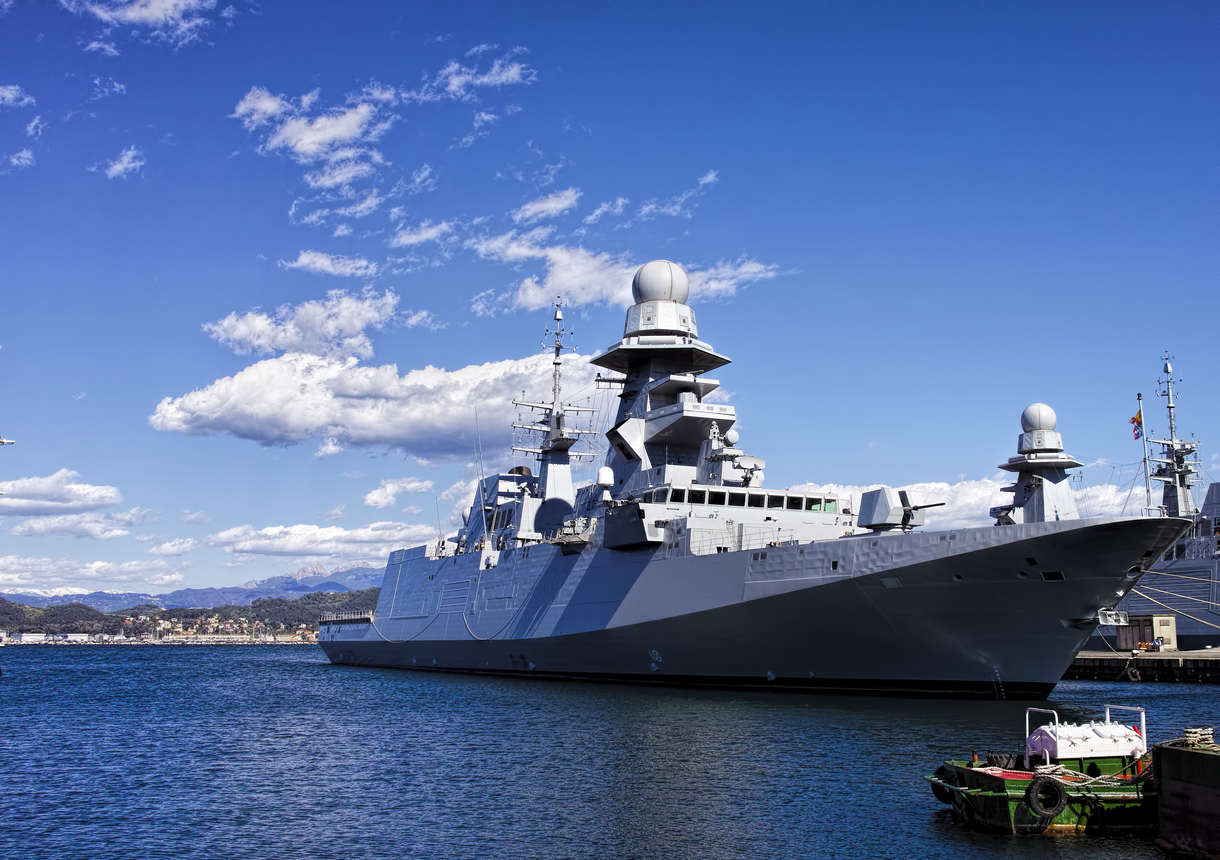
Destroyers are among the most technologically sophisticated warships of all. Their task is not just „lots of firepower“, but a constant balancing act: Large range during economic marching, High top speed for the spurt, Lowest possible noise signature for submarine hunting and the integration of sensors, weapons, power supply and IT in a single, seaworthy overall system. This is precisely where the strength of modern shipyards comes to the fore: they have to combine conflicting requirements into a functioning, maintainable and (above all) safe overall architecture.
Table of contents
- The complex systems of destroyers and how shipyards integrate them
- Drive concepts: CODOG, CODAG and CODLAG in everyday shipyard use
- Dimensions, space requirements and technological reserves of modern destroyers
- Modular design, integration, redundancies and confidentiality
- Combat management system, sensor technology and automated response
- Testing, commissioning and project management under realistic loads
- Further topics
Estimated reading time: 10 minutes

The complex systems of destroyers and how shipyards integrate them
Modern destroyers are not „large ships“ in the traditional sense, but highly integrated weapon systems. Their performance results from the interaction of many subsystems - and one of the most challenging issues is the propulsion system. This is because a destroyer should provide range and efficiency for long marches, but also be able to accelerate very quickly if necessary. At the same time, the acoustic signature is crucial: the louder the engines, the easier it is to locate the ship - and the more difficult it is to detect even an enemy submarine, because sonar systems „hear“ what is happening in the water.
Shipyards and customers are therefore faced with a typical conflict of objectives: diesel engines are ideal for achieving a long range at low or medium speeds, as they work efficiently. Gas turbines, on the other hand, enable high top speeds and fast sprints, but consume significantly more fuel. There are also design challenges: Diesels and turbines have different speed ranges, different vibration and noise profiles and require their own supply and monitoring systems. This is precisely why modern destroyers rely on combined drive concepts that provide the right operating mode depending on the situation.
Drive concepts: CODOG, CODAG and CODLAG in everyday shipyard use
An established basic principle is the CODOG concept („Combined Diesel Or Gas“). Here, the destroyer carries diesel engines for cruising and gas turbines for high-speed travel. The advantage lies in the clear distribution of tasks: in normal driving profiles, the diesels provide range and fuel consumption advantages. However, if a fast sprint is required - for example to reach a position, to face a threat or to reinforce an escort - the turbines take over. The mechanical separation is crucial here: as diesel and turbines operate at very different speeds, a gearbox decouples the engine that is not required so that only „diesel or gas“ ever acts on the shaft. This reduces conflicts in the system, but increases the demands on the gearbox, clutches and the associated control system.
A more advanced version is CODAG („Combined Diesel And Gas“). In contrast to CODOG, diesel and turbine can provide power together if the profile requires it. In practice, this is challenging because the forces of both systems have to be balanced via complex transmission structures. Alternatively, there are designs in which diesel engines drive conventional shafts, while the gas turbine also operates via a water jet drive. The technical advantage lies in more flexible performance levels: The ship can become faster without immediately switching to a purely turbine-driven, fuel-intensive mode. At the same time, however, complexity, integration costs and the need for monitoring increase - because many operating states must be safely controlled, even during load changes and in heavy seas.

CODLAG („Combined Diesel Electric And Gas“) is particularly interesting for destroyers that are designed more for submarine hunting or generally for low-noise operation. Here, diesel engines primarily drive generators that provide electrical energy during cruising. This energy supplies electric motors that drive the shafts. The decisive advantage is that electric motors - correctly designed and decoupled - can be operated very quietly, which reduces the acoustic signature. For particularly quiet journeys, the diesel engines can be switched off while batteries power the electric motors. If, on the other hand, high speed is required, gas turbines are also switched on. This creates a drive system that can be optimised for economy, low noise or maximum performance, depending on the situation.
From the shipyard's point of view, the task does not end with the selection of the principle. Complex drives such as CODAG and CODLAG require advanced control and monitoring systems that coordinate loads, temperatures, vibrations, speeds and switching states in real time. The aim is not only performance, but also efficiency and service life: incorrectly timed load changes, unfavourable vibration conditions or sub-optimal operating modes can increase wear, worsen the signature and reduce availability. This is why propulsion, power generation, electrical distribution and automation are considered as a complete system - and it is precisely this complete system that must be properly integrated, tested and documented during the shipbuilding process.
Dimensions, space requirements and technological reserves of modern destroyers
Destroyers start at a displacement of around 4,000 tonnes, but that is only the lower end. Depending on the mission, equipment and national requirements, modern units can range up to 15,000 tonnes. Typical lengths are approximately between 100 and 165 metres. This size range is not an end in itself: it arises from the need to accommodate a large number of systems and at the same time ensure stability, seaworthiness and reserves for modernisation.
In addition to the propulsion system, a destroyer carries large volumes of weapons and sensor systems. These include, for example, vertical launch systems (VLS) with their magazines, radars with high power consumption, additional sensors, communication systems and other effective systems. There is also the area for aircraft: helicopter hangars and deck areas require space, weight and structural reinforcements. At the same time, the crew must have sufficient living space, work areas and safety zones. There are also storage areas for food, spare parts, lubricants and operating resources - and of course fuel capacities that make the mission profile possible in the first place.
Even small changes in requirements can have a major impact on the design and layout. For example, if a client requires more range, additional sensors or larger aircraft, not only do individual components grow, but often also the supporting infrastructure: more energy requirements, stronger cooling, additional cable routes, larger switch rooms, stronger shielding and often new safety and redundancy concepts. This is precisely why shipyards and design offices plan in technological reserves from the outset. This is because systems become more complex during their life cycle: communication and sensor systems grow, software scopes increase and the number of interfaces increases. Without reserves, any modernisation would be expensive, risky and time-consuming.
Modular design, integration, redundancies and confidentiality
Destroyers are not only complex, but also particularly sensitive. Many components are subject to secrecy regulations, and this applies to both the technology itself and the way it is integrated. Shipyards meet this challenge with modular construction methods and highly structured production. Large sections are prefabricated, in which cable routes, pipework and supply infrastructure are already installed. This creates a „basic architecture“ at an early stage, on which weapon, sensor and guidance modules can later be placed.
In the integration phase, this is followed by what makes destroyers a genuine system network: the integration of VLS cells, weapon stations, sensor masts, communication nodes and, above all, the control rooms. Redundancy is important here. Modern units have central functions not just once, but multiple times. This is particularly true for command and control: a single command post can fail in combat, so the command and control capability must be maintained by additional, independent systems. For the shipyard, this means additional rooms, additional cabling, additional power and cooling lines - and a consistent separation of systems so that damage does not affect everything at the same time.
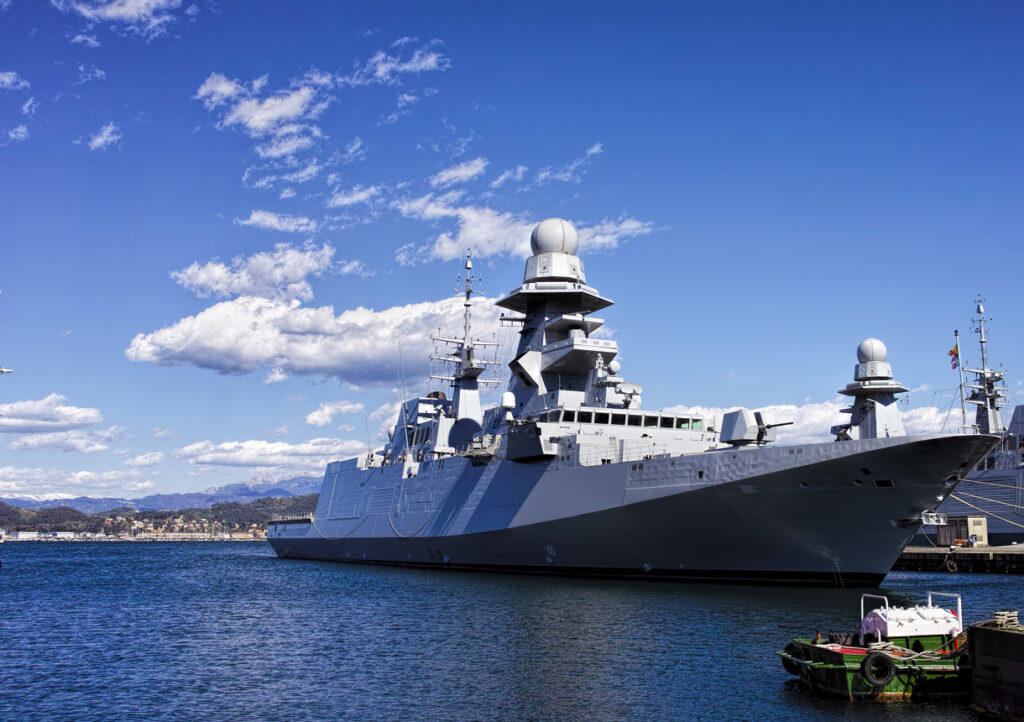
Another key area is electromagnetic shielding. Sensors and communication systems operate at high power levels, many systems transmit and receive in parallel, and sensitive electronics must be protected against interference. Engineers ensure that mechanical fastenings not only hold structurally, but are also vibration and electromagnetically clean. Especially with the large number of antennas, radar subsystems and data lines, this is an integration task that cannot be done on the side, but requires a separate planning and test programme.
Combat management system, sensor technology and automated response
In order for a destroyer to be effective in an emergency, sensors and weapons must converge in a centralised network: the Combat Management System. This is where sensor data is merged, targets are classified and - depending on the scenario - combat sequences are prepared or triggered automatically. Modern threats in particular require extremely short reaction times. This is why the ability to partially automate processes is not a „nice-to-have“, but is absolutely essential in certain situations.
One example is sea skimmers: guided missiles that fly just a few metres - sometimes only one or two metres - above the surface of the water. Due to the curvature of the earth and shadowing by waves, such targets are often only detected very late. Then there are only seconds to react. Humans are often unable to detect, decide and trigger quickly enough during this time. A computer network, on the other hand, can recognise patterns, calculate target priorities and control defence systems in order to achieve the required reaction speed. This is precisely why data lines, interfaces and system logic must be designed from the outset to be robust, redundant and testable under load.
Testing, commissioning and project management under realistic loads
Integration is followed by the phase in which many subsystems are turned into an operational ship: start-up, checking and testing. Systems are not only considered individually, but also in combination. Energy supply, cooling, communication, sensors, propulsion and automation must run stably under realistic load conditions. At the same time, shipyards are under pressure to maintain confidentiality and work in close coordination with clients. This requires precise project management, clear milestones, defined test procedures and complete documentation.
Only when the systems interact reliably, the redundancies work and the performance values are achieved even under demanding scenarios is a destroyer considered truly operational. This is precisely where it becomes clear why integration in the shipyard is an area of expertise in its own right: it is not just about „installation“, but about the controlled integration of a highly complex, safety-critical and sensitive system network.
Further topics
Modern destroyers are constantly evolving. Topics such as directed energy weapons, advanced sensor fusion and new propulsion technologies are becoming increasingly important.